
This comprehensive guide decodes the technical jargon of text message marketing. You will discover detailed definitions, actionable insights, and real-world examples for essential industry terms. Master these concepts to boost engagement, ensure compliance, and maximize the return on investment for your mobile campaigns.
Are confusing acronyms holding back your text campaigns? This SMS Marketing Glossary: Key Terms You Need to Know gives you the clarity required to dominate mobile marketing.
A-C: Essential Texting Terminology
A/B Testing
A method of comparing two variations of a text message to see which performs better. You can test different copy, send times, or offers.
- Actionable Insight: Always test one variable at a time to understand exactly what caused the performance shift.
- Example: Sending Version A with a 10% discount and Version B with free shipping to see which yields a higher click-through rate.
Application-to-Person (A2P)
A2P refers to business-based text messages sent from a software application to a consumer’s mobile device, rather than from another person’s phone.
- Actionable Insight: Ensure your business texting software is fully optimized for A2P delivery to avoid carrier filtering.
- Example: An automated appointment reminder sent from your booking software to a client.
Autoresponder
An automated message triggered when a subscriber texts a specific keyword to your number.
- Actionable Insight: Keep autoresponders concise and immediately deliver the value or information the customer requested.
- Example: A customer texts “HOURS” and instantly receives an automated reply with your store’s opening times.
Bounce Rate
The percentage of your messages that could not be delivered to the recipient’s mobile device.
- Actionable Insight: Regularly clean your subscriber list to remove disconnected numbers and keep your bounce rate low.
- Example: Sending 1,000 texts and having 50 fail to deliver results in a 5% bounce rate.
Call to Action (CTA)
The specific instruction you give your audience to provoke an immediate response.
- Actionable Insight: Use strong, active verbs and create a sense of urgency.
- Example: “Click here to claim your 20% off code before midnight!”
Carrier
The mobile network operator (like Verizon, AT&T, or T-Mobile) that provides cellular services to consumers.
- Actionable Insight: Follow carrier guidelines strictly to prevent your SMS campaigns from being marked as spam.
- Example: T-Mobile routing your promotional text to your subscriber’s smartphone.
Cellular Telecommunications Industry Association (CTIA)
A trade organization that represents the wireless communications industry in the United States. They set best practices and guidelines for text marketing.
- Actionable Insight: Familiarize yourself with CTIA guidelines to ensure your campaigns maintain high deliverability and compliance.
- Example: The CTIA dictates that you must include “Msg & Data rates may apply” in your promotional opt-ins.
Click-Through Rate (CTR)
The percentage of recipients who clicked on a link included in your text message.
- Actionable Insight: Use branded, shortened links to build trust and track your CTR accurately.
- Example: If 100 people receive your text and 15 click the link, your CTR is 15%.
Conversion Rate
The percentage of users who completed the desired action (like making a purchase) after clicking the link in your message.
- Actionable Insight: Ensure your landing page is mobile-optimized so users can easily convert after clicking your text link.
- Example: Out of 15 people who clicked your link, 3 made a purchase, yielding a 20% conversion rate from clicks.
D-F: Delivery and Engagement Terms
Delivery Rate
The metric showing the percentage of messages successfully delivered to subscriber inboxes.
- Actionable Insight: Monitor this closely. A sudden drop in delivery rate often signals a carrier filtering issue.
- Example: Delivering 9,800 out of 10,000 sent messages means a 98% delivery rate.
Drip Campaign
An automated sequence of text messages sent to subscribers based on a predefined schedule or specific user actions.
- Actionable Insight: Map out your drip campaign to nurture leads slowly rather than overwhelming them with constant promotions.
- Example: A welcome series that sends a greeting on day one, a discount code on day three, and a product guide on day seven.
Dynamic Content
Content that changes based on the data you have about the recipient, creating a personalized experience.
- Actionable Insight: Use merge tags to insert customer names or recent purchase data to boost engagement.
- Example: “Hi [First Name], we noticed you left [Product] in your cart!”
Express Written Consent
The explicit permission a consumer gives a business to send them promotional text messages. This is a strict legal requirement.
- Actionable Insight: Never buy phone number lists. Always use opt-in forms with clear disclosures to gather text marketing subscribers.
- Example: A customer checking a box at checkout that says, “I agree to receive promotional text messages.”
G-L: Growth and Logistics
Geofencing
A location-based service that triggers a text message when a mobile device enters or exits a virtual boundary set up around a geographic location.
- Actionable Insight: Use geofencing to drive foot traffic to brick-and-mortar stores by sending timely local offers.
- Example: Texting a free coffee coupon to a subscriber when they walk within two blocks of your cafe.
Keyword
A specific word that customers text to your short or long code to opt into your subscriber list or trigger a response.
- Actionable Insight: Choose keywords that are short, memorable, and free of special characters to prevent autocorrect errors.
- Example: “Text PIZZA to 12345 to join our VIP club.”
Long Code
A standard 10-digit phone number used to send and receive text messages.
- Actionable Insight: Use long codes for localized marketing or two-way conversational customer service.
- Example: A local plumbing service texting from 555-123-4567 to coordinate arrival times.
M-P: Messaging Formats and Protocols
Multimedia Messaging Service (MMS)
A message that includes multimedia content like images, GIFs, audio, or video, along with a higher character limit than standard texts.
- Actionable Insight: Use MMS for highly visual products or to stand out during heavy promotional seasons like Black Friday.
- Example: Sending a text that includes an animated GIF of your new clothing line.
Opt-In
The process where a consumer agrees to receive communications from your brand.
- Actionable Insight: Offer a compelling incentive, like a discount or exclusive content, to encourage more opt-ins.
- Example: A website pop-up offering 15% off a first order in exchange for a mobile number.
Opt-Out
The action a subscriber takes to remove themselves from your messaging list.
- Actionable Insight: Always provide a clear and easy way for users to opt out to remain compliant with privacy laws.
- Example: Including “Reply STOP to cancel” at the end of your promotional messages.
Person-to-Person (P2P)
Standard text messaging between two individual mobile users.
- Actionable Insight: Do not use P2P networks for bulk business messaging, as carriers will quickly block your number.
- Example: Texting your friend to ask what time you are meeting for dinner.
Q-S: Strategy and Segmentation
Return on Investment (ROI)
A metric used to evaluate the financial efficiency and profitability of your text marketing campaigns.
- Actionable Insight: Track your spend against your revenue generated through ecommerce tracking tools to prove the value of your campaigns.
- Example: Spending $100 on a campaign that generates $1,000 in sales equals a 1000% ROI.
Segmentation
The practice of dividing your subscriber list into smaller groups based on specific criteria like demographics, purchase history, or engagement levels.
- Actionable Insight: Send highly targeted offers to specific segments rather than blasting your entire list with the same message.
- Example: Creating a segment of customers who have purchased dog food and sending them a promo for dog treats.
Sender ID
The name or number that appears on the recipient’s phone to identify who the message is from.
- Actionable Insight: If operating internationally, use an alphanumeric sender ID (like your brand name) to increase recognition and trust.
- Example: A message arriving on a phone labeled as “BrandName” rather than a random string of numbers.
Short Code
A 5- or 6-digit phone number used primarily for high-volume, bulk mass messaging.
- Actionable Insight: Use a dedicated short code if you plan to send hundreds of thousands of messages a month.
- Example: Texting a keyword to 55555 to enter a sweepstakes.
Short Message Service (SMS)
The standard text-only messaging format, typically limited to 160 characters per message.
- Actionable Insight: Keep your SMS copy punchy and direct. If you exceed 160 characters, the message may break into multiple texts.
- Example: Sending a brief flash sale alert with a link to your store.
T-Z: Tracking and Compliance
Telephone Consumer Protection Act (TCPA)
A US federal law regulating telemarketing, including automated text messages. It requires businesses to obtain prior express written consent before texting consumers.
- Actionable Insight: Consult with legal counsel to ensure your opt-in compliance strategies meet all TCPA requirements to avoid massive fines.
- Example: Providing clear terms of service and privacy policy links near your phone number capture forms.
Transactional Message
An automated message triggered by a user’s action, providing necessary information rather than promotional content.
- Actionable Insight: Use transactional texts to build customer trust by keeping them informed about their purchases.
- Example: An order confirmation or a shipping update with a tracking link.
Uniform Resource Locator (URL)
The web address you include in your message to direct users to your site.
- Actionable Insight: Always use a link shortener to save valuable character space and track clicks.
- Example: Using a branded short link like “brand.co/sale” instead of a long, messy web address.
Comparing Number Types: Short Code vs. Long Code vs. Toll-Free
Choosing the right sender number is vital. Use this comparison table to decide which fits your strategy.
|
Feature |
Short Code |
10-Digit Long Code (10DLC) |
Toll-Free Number |
|---|---|---|---|
|
Format |
5 or 6 digits |
10 digits (Local area code) |
10 digits (e.g., 800, 888) |
|
Best For |
High-volume mass marketing |
Localized marketing, customer service |
Medium-volume alerts, support |
|
Throughput Speed |
Extremely fast (100+ msg/sec) |
Slower (varies by carrier trust) |
Moderate to fast |
|
Cost |
Very High |
Low to Moderate |
Moderate |
|
Two-Way Messaging |
Limited |
Excellent |
Excellent |
Mini-Conclusion: For large enterprises focused on blasting promotions, short codes win. For local businesses building relationships, long codes are the most authentic choice.
Common Mistakes to Avoid in Text Campaigns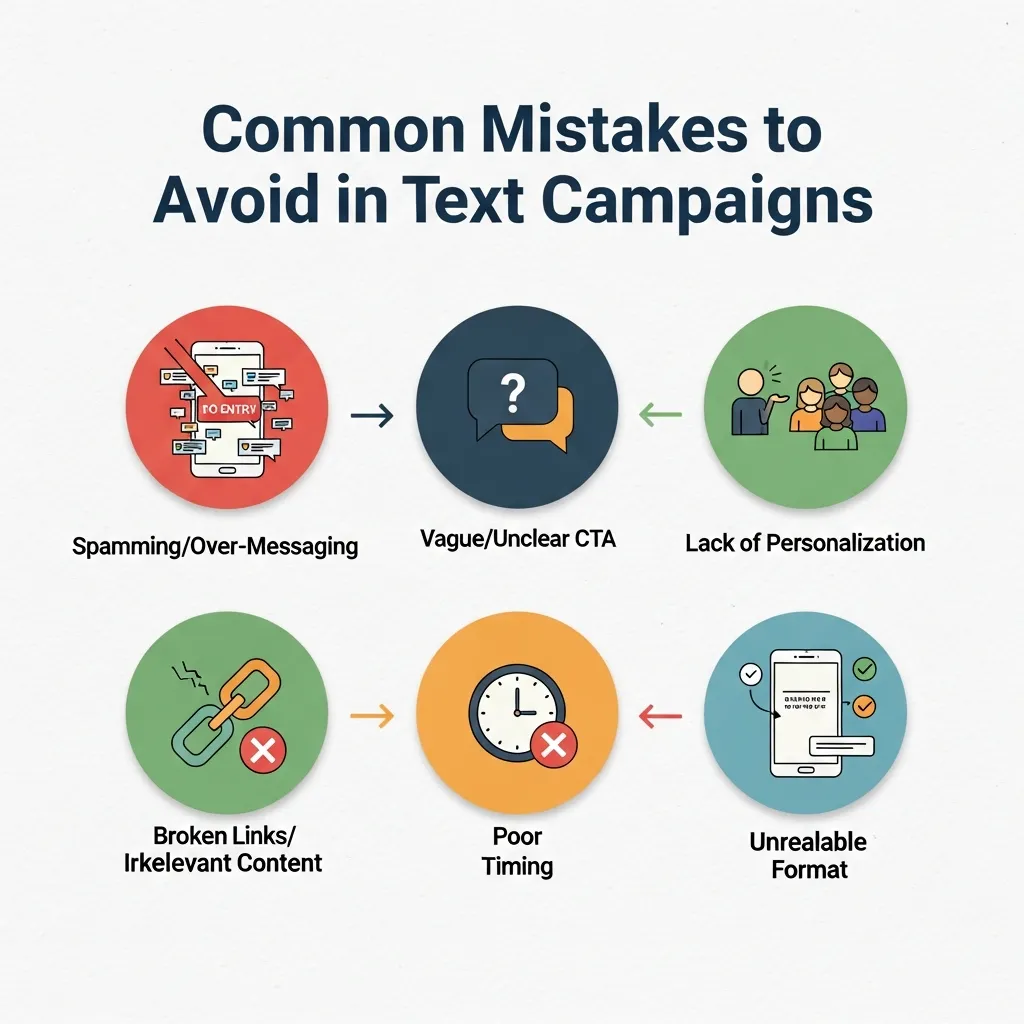
Even veteran marketers slip up. Avoid these costly errors when building your campaigns.
- Ignoring Time Zones: Nobody wants a promotional text at 3:00 AM. Always segment your audience by time zone and schedule your broadcasts during appropriate waking hours.
- Forgetting to Identify Yourself: If you do not use a branded sender ID, always state your brand name in the first few words of the text. Do not assume the customer has your number saved.
- Using Too Much Slang: While texting is a casual medium, relying heavily on abbreviations (like “UR” or “GR8”) can make your brand look unprofessional and trigger spam filters.
- Over-Messaging: Sending texts too frequently leads to high opt-out rates. Find a cadence that keeps your audience engaged without annoying them.
- Neglecting Compliance: Never text a customer who hasn’t explicitly opted in. Ignoring TCPA guidelines can lead to severe legal and financial repercussions.
Pro Tips and Expert Insights
To truly excel, go beyond the basics. Here are expert strategies to elevate your results.
- Leverage FOMO (Fear of Missing Out): Texting is an immediate channel. Create flash sales that only last for a few hours to drive instant conversions.
- Use Multimedia Strategically: MMS costs more to send than standard texts. Reserve images and GIFs for your biggest product launches or holiday sales where the visual impact will drive the most revenue.
- Integrate with Email: Do not treat mobile and email as competing channels. Use email for long-form content and newsletters, and use texts for urgent alerts and final reminders.
- Automate the Customer Journey: Set up triggered flows for abandoned carts, welcome series, and post-purchase follow-ups. Automation drives revenue while you sleep.
- Keep Your List Clean: Regularly prune unengaged subscribers. A smaller, highly engaged list is far more profitable than a massive list of people who ignore your messages.
Conclusion
Understanding this SMS Marketing Glossary: Key Terms You Need to Know is the first step toward building a highly profitable mobile strategy. By mastering the terminology, staying compliant, and leveraging best practices, you can connect with your audience instantly. Ready to elevate your campaigns? Start applying these concepts to your marketing today and watch your engagement soar.
Frequently Asked Questions (FAQs)
1. What is the difference between SMS and MMS?
SMS (Short Message Service) is a text-only format limited to 160 characters. MMS (Multimedia Messaging Service) allows you to include images, videos, audio, and GIFs, and typically has a much higher character limit (often up to 1,600 characters).
2. Why do I need express written consent to text customers?
written consent is required by the Telephone Consumer Protection Act (TCPA) in the United States. It protects consumers from unwanted spam. Failing to secure this consent before sending promotional messages can result in heavy legal fines and carrier bans.
3. What is a good opt-out rate for a campaign?
A healthy opt-out rate is typically under 1% per campaign. If you notice your opt-out rate creeping higher, you are likely messaging your audience too frequently or providing content they do not find valuable.
4. How can I measure the success of my text campaigns?
Track key performance indicators (KPIs) such as delivery rate, open rate, click-through rate (CTR), and conversion rate. Using trackable, shortened links is the best way to see exactly how much revenue a specific message generated.
5. What is A2P 10DLC?
A2P 10DLC stands for Application-to-Person 10-Digit Long Code. It is a system implemented by US carriers that allows businesses to send commercial texts using standard local phone numbers, providing better deliverability than older long code methods once the business is verified.
6. Can I buy a list of phone numbers to start marketing?
No. Buying phone number lists is illegal under the TCPA and violates the terms of service of virtually every messaging provider. You must build your list organically through opt-in forms, keywords, and genuine customer consent.
7. How do I prevent my messages from being filtered by carriers?
To avoid carrier filtering, maintain strict compliance, avoid spammy language (like excessive capital letters or symbols), ensure your links are secure, and remove inactive or invalid numbers from your subscriber list regularly.
8. What does SHAFT mean in text marketing?
SHAFT is an acronym for Sex, Hate, Alcohol, Firearms, and Tobacco. The CTIA strictly regulates or outright bans messaging related to these topics. If your business falls into these categories, you must navigate severe restrictions and age-gating requirements.
9. How frequently should I text my subscribers?
Most successful brands text their audience 2 to 4 times a month. However, this depends on your industry and the value of your messages. Always monitor your engagement and opt-out rates to find the sweet spot for your specific audience.
10. What is an SMS aggregator?
An aggregator acts as a bridge between your marketing software and the wireless carriers. They build and maintain the technical infrastructure required to route your messages from the application directly to the consumer’s mobile network.
(For further reading on compliance and industry standards, you can review resources provided by the Federal Communications Commission or the CTIA).